10 Billion Challenge: Agriculture’s Critical Juncture
By 2050, the world will house 10 billion people, yet
agricultural land, currently 37.70% of
total land space, is shrinking. The collision between the
growing population and diminishing farmland demands an
agricultural revolution. The
$2.4 trillion global agriculture industry
will witness AI investments surging from
$1 billion today to an anticipated
$4 billion by 2026. India exemplifies the
transformation challenge: employing
54.41% of its workforce in agriculture
yet generating only 14.39% of GDP,
highlighting a critical productivity paradox.
Recognition of this urgency has prompted decisive
government action. NITI Aayog’s nationwide AI strategy
designates agriculture as one of the three thrust sectors
alongside healthcare and fintech. The Ashok Dalwai
Committee on Doubling Farmer Income has charted the path
forward, technological solutions including sensor drones,
big data analytics, GIS mapping, and AI-driven automation.
Accenture research suggests AI-based digital farming could
affect 70 million Indian farmers, potentially generating
$9 billion in additional income. These
systems are already operational today, creating a vast
digital ecosystem that bridges traditional farming with
the future.
Precision Farming: Science of Site-Specific Management
Precision farming reimagines agriculture through
site-specific management, tailoring farming actions to
individual fields or plants. Traditional one-size-fits-all
methods lead to resource inefficiencies, whereas precision
farming leverages data-driven insights to allocate water,
fertilisers, and pesticides exactly where and when they
are needed.
Professor Pierre Robert, the pioneer of precision farming,
described it as ‘an information revolution facilitated by
new technologies’. Modern precision agriculture employs
GPS guidance, automated irrigation systems, soil scanning
technologies, data analysis, robotics, and drone-based
remote sensing to optimise resource management while
enhancing productivity.
AI and IoT Integration: Smart Farming Revolution
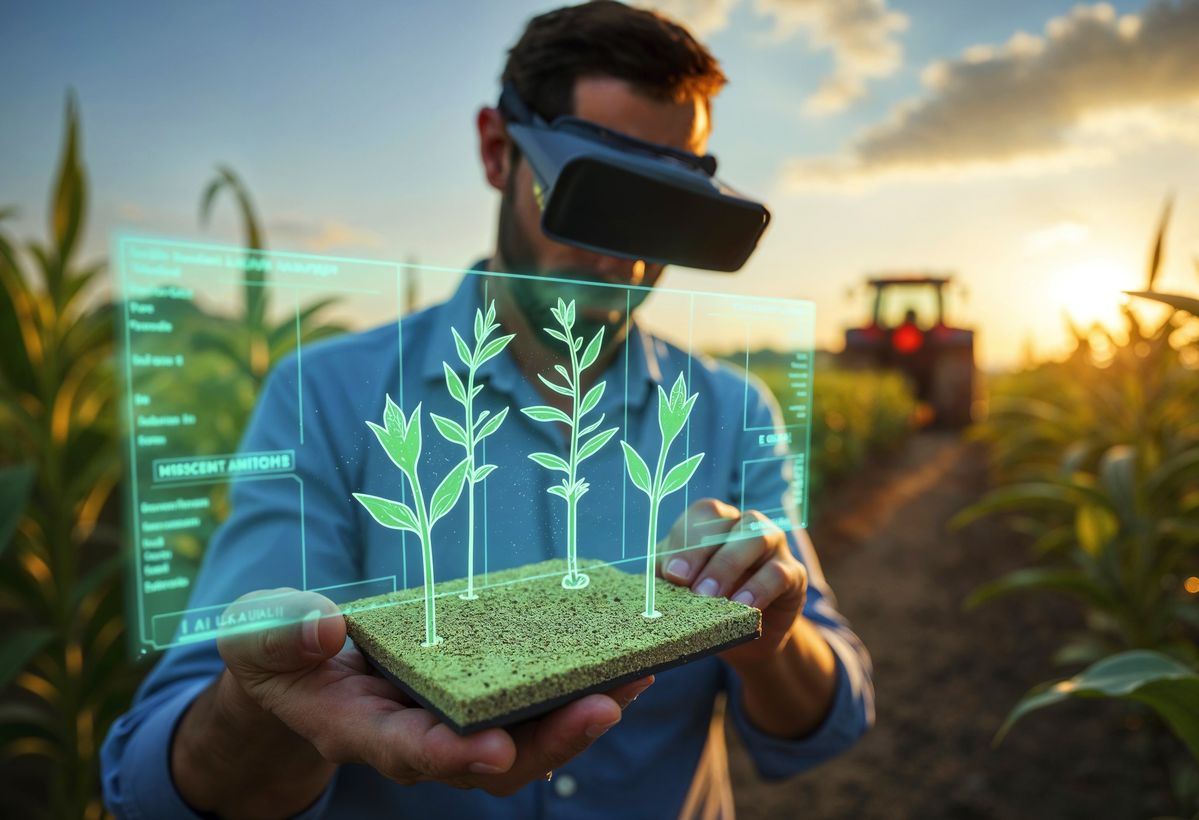
The convergence of AI and IoT enables the creation of
comprehensive cyber-physical systems for farm management.
AI applications span soil management, crop health
monitoring, disease detection, and weed control.
Key innovations include mobile expert systems that allow
farmers to diagnose crop diseases, identify species, and
assess soil health using smartphones. Real-time satellite
analysis monitors farming progress and informs
optimisation strategies. Advanced communication
technologies, including 5G, LoRaWAN, and NB-IoT, enable
remote real-time monitoring and data processing.
LoRa technology stands out for its range, low cost, and
ability to support numerous nodes simultaneously, making
it particularly suitable for agriculture.
Transformative Farming: Applications that Matter
Real-Time Monitoring and Automation
IoT devices enable real-time monitoring of weather
conditions, soil quality, crop health, and growth
patterns. Sensors placed strategically across fields
collect data on microclimates, soil moisture, nutrient
levels, and pest activity. IoT-enabled irrigation systems
calculate precise water requirements for each plant,
optimising usage while conserving resources.
Prevention
Continuous IoT data collection powers predictive models
for crop yields, pest outbreaks, and livestock health.
AI-driven drones capture high-resolution crop images
processed through advanced algorithms. Spectral and
infrared imaging can detect plant stress long before human
observation, enabling proactive intervention.
Supply Chain Optimisation
Smart labels on produce track temperature, humidity, and
light exposure during transportation, ensuring freshness
and safety. Advanced labels can even detect pathogens,
providing transparency throughout the farm-to-retail
journey.
Internet of Underground Things (IoUT)
Wireless sensors placed below ground monitor soil
moisture, nutrient levels, pH, and electrical
conductivity, offering unprecedented insight into soil
conditions and enabling data-driven fertilisation and
irrigation decisions.
Technology Arsenal
Modern agriculture also leverages high-throughput
phenotyping, remote sensing, and AgroBots (automated
robots) for harvesting, sorting, and weed detection,
reducing labor costs and environmental impact. Spectral
imaging and robotics collect plant trait data to guide
precise fertilisation, irrigation, and pest management.
Advanced image segmentation ensures accurate plant and
fruit detection even under variable lighting. Integration
of 5G and future 6G networks promises improved
connectivity, lower latency, and broader adoption of these
innovations.
Building Agricultural Resilience
AI and IoT enable advanced image processing, machine
vision, and real-time environmental monitoring. Autonomous
robots handle labour-intensive tasks while reducing
environmental impact through precise resource application.
These technologies, when scaled, promise efficiency,
higher yields, and sustainable farming practices.
The convergence of AI and IoT represents agriculture’s
most significant transformation since mechanisation. These
innovations empower farmers with data-driven solutions,
improving efficiency and productivity while promoting
sustainability. As technology evolves, precision
agriculture will continue to reshape the farming
landscape, offering higher yields, reduced waste, and
resilient food systems. The agricultural revolution has
begun, and success demands immediate action, sustained
investment, and collaborative commitment to bridging the
digital divide so these technologies serve all farmers,
regardless of scale or geography.